
The SPACE framework: 5 questions for a (more) organised life

New year, new you? Introducing the SPACE framework, created by yours truly.
Summary: SPACE is an organisation framework consisting of five diagnostic questions: Systems (what to externalise), Preparation (what to do in advance), Awareness (what data reveals), Curation (what to decline), and Evolution (how to adjust). Developed by Jess Allison over 20 years of operations management, it works across tools and life phases.
You already have systems. The way you manage your calendar, pay bills, coordinate with your partner... those are systems! Some work well. Some are held together with mental duct tape and anxiety.
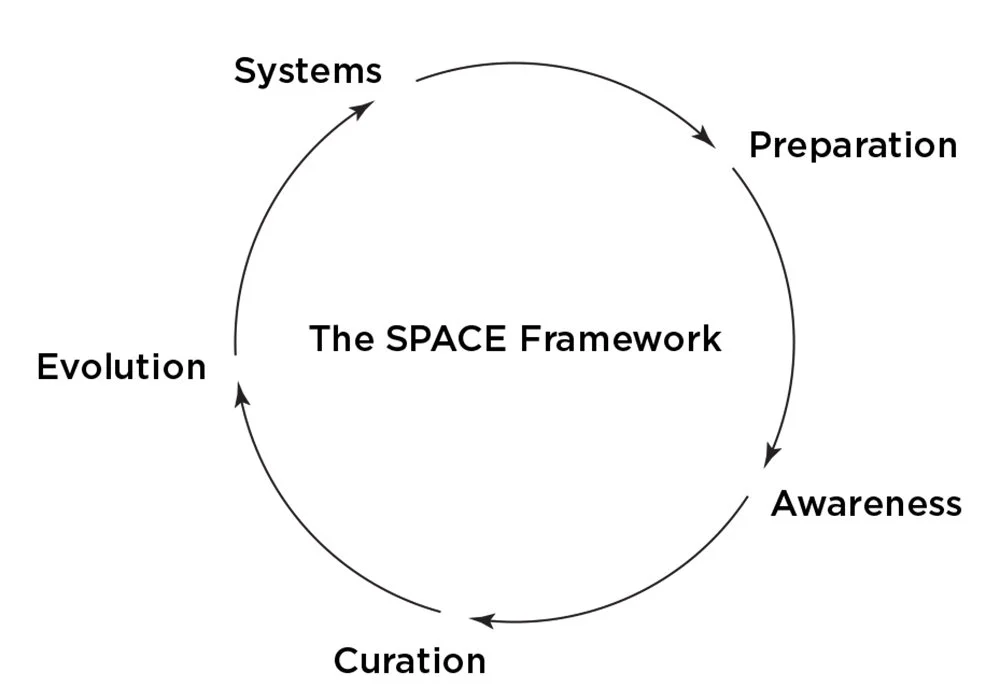
The SPACE Framework
The SPACE framework helps you evaluate what's there and make it better:
What can I systematise (or systematise better)?
What can I prepare in advance?
What data will give me awareness of what's really happening?
What can I say no to, that will better curate my time?
How can I evolve this?
I developed this framework over 20 years managing operations across project delivery, business management, and household coordination. They're the principles I run my life by to this day.
Systems: Externalise what you're trying to remember

The question: What can I externalise or systematise better?
Systems means taking what you're tracking mentally and putting it somewhere external that does the remembering for you.
Example: Shared car calendar
My partner and I share one car. We already had a system: ask each other "do you need the car tomorrow?" This worked until we both said "probably not" then both needed it.
Next: a dedicated car calendar in Google Calendar. Better, but when one of us added a booking, the other wouldn't get a notification. Double-booking continued.
The evolution? We now create a calendar event and invite the other person, which triggers a notification.
Preparation: Small investments that compound

The question: What could I do now to make this easier later?
Learning keyboard shortcuts feels inefficient when you're busy, but those seconds compound over time. Setting up an email template takes five minutes once, then saves you typing the same thing 50 times.
Example: Tax folder
I create a new tax folder on 1 July each year. Throughout the year, every receipt, invoice, or tax document goes straight in. When tax time arrives, everything's there.
The preparation takes 30 seconds, maybe another 30 seconds each time I save a receipt there. Preparing my tax return is easy (who says that?), the work is already done.
Awareness: Reality versus perception

The question: What data am I collecting, and what does it tell me?
You think you're working eight focused hours. A time audit reveals it's more like three, fragmented by meetings. You think you spend $300 monthly on groceries. The bank statement says $480.
Example: Weekly review
Every Friday, I spend 30 minutes reviewing what happened that week and what's coming next. What tasks got done, what fell through cracks, where my time actually went versus where I planned to spend it.
I might notice I'm consistently underestimating how many ad-hoc support requests will come through, or that admin piles up on Thursdays (after my part time day off on Wednesday). That awareness lets me adjust: maybe I block Thursday mornings for admin, and add more buffer when time blocking tasks in my day.
Curation: Protecting capacity by saying no

The question: What should I say no to?
Every yes is a no to something else. Say yes to a 7pm networking event, you're saying no to being home for dinner.
Example: Calendar blocks
I have two hour blocks on Tuesday and Thursday mornings that are untouchable. No meetings, no calls, no exceptions. This is when my deep work happens.
Protecting those blocks means saying no to meeting requests that would be "just as convenient" on Tuesday morning. It feels inflexible, but it's the only way I protect my capacity for work that moves the needle in my role.
Evolution: Systems break, then you fix them

The question: How do I adjust when this breaks?
You have a baby and your morning routine collapses (along with everything else, lol). You change jobs and your task management system doesn't fit the new workflow. You move house and your filing system doesn't make sense anymore.
Example: Car calendar evolution
Back to the shared car calendar. Our first version was a separate calendar we both had view access to. That worked until we realised neither of us got notifications when the other person booked the car.
We didn't abandon it. We evolved it. Now when you book the car, you create the event and invite the other person, which triggers a notification. The notification acts as a request to use the car, as opposed to a firm booking.
If that stops working, we'll adjust again.
Apply SPACE
Pick something you're already managing, like client projects, household tasks, meal planning, or your fitness routine. Work through the five questions.
You won't need all five every time. Maybe you already do bulk meal prep on Sundays, but you want to evolve your menu to focus on higher protein. Maybe you want to run a half marathon next year and need to map out a training plan to get your there. Or maybe you find yourself writing proposals from scratch every time, when you could setup a system for spinning up a template based on the type of project it is.
Why tool-agnostic matters
The framework isn't tied to specific apps. It doesn't matter if you use Asana, Notion, Todoist, Trello, Google Calendar, or a paper notebook, the same questions apply. Your systems survive when apps shutdown, or you switch.
What SPACE solves
Systems that break when life changes. Productivity methods tied to obsolete apps. Organisation advice requiring perfect circumstances. Task management relying on willpower. Feeling constantly behind despite trying multiple systems.
Getting started
Start with Systems and Awareness. Get your current approach into one visible place. Do a weekly review to see what's working and what isn't.
Layer in Preparation as you notice friction points. Learn a keyboard shortcut when you keep doing the same thing manually. Create an email template when you realise you're typing the same response repeatedly.
Notice when you need Curation, say when you're feeling overcommitted or drowning in obligations. Practice saying no.
Expect Evolution. Your system will need adjusting. Life will change. That's not failure, it's being human, baby.
The complete SPACE framework, including detailed systems and workflows, is in my book The Most Organised Person I Know.
FAQ
Is the SPACE framework a productivity system or a framework?
It’s a framework, diagnostic questions you apply to any system. Unlike productivity systems (which tell you exactly what to do), SPACE helps you evaluate and improve what you’re already doing.
Can I use SPACE with my current tools?
Yes. It works with whatever you use; Notion, paper notebooks, Google Calendar, spreadsheets.
Do I need to implement all five principles?
No. Start with Systems, or whatever you’re drawn to. Add others as needed.
What if I’m not naturally organised?
Organisation isn’t a personality trait. It’s external systems doing the remembering for you.
How is this different from other productivity methods?
Most methods are specific systems. SPACE is questions you apply to any system or area of your life.
I’ve tried organisation systems before and they failed.
Most systems assume stable circumstances. SPACE is different, Evolution is built in. When life changes, you adjust the system rather than abandon it.
Ready to feel more organised without overhauling your whole life?
The Most Organised Person I Know is a practical guide to building systems that reduce mental load, support your energy, and keep working when life gets messy.
Inside you’ll find:
The SPACE framework: five principles that underpin every effective organisation system (Systems, Preparation, Awareness, Curation, Evolution)
100+ practical organisation improvements with real examples
How I use these principles in my own life and how you can adapt them for yours
Designed for freelancers, parents, and small business owners who need systems that work during real-life chaos, not just in ideal conditions
Make space. Keep space. That’s what this book teaches you to do.