The Most Organised Person I Know

I wrote a book for you! It includes the SPACE framework for organising your life around five basic principles (and no productivity theatre).
Summary: Productivity systems break when life changes because they're built on willpower and ideal conditions. The Most Organised Person I Know (book) is built on five principles instead: Systems, Preparation, Awareness, Curation, Evolution. It covers task management, email workflows, shared household admin, boundaries and a 30-minute weekly review, works with whatever tools you already use, and includes zero productivity theatre.
I wrote it all down
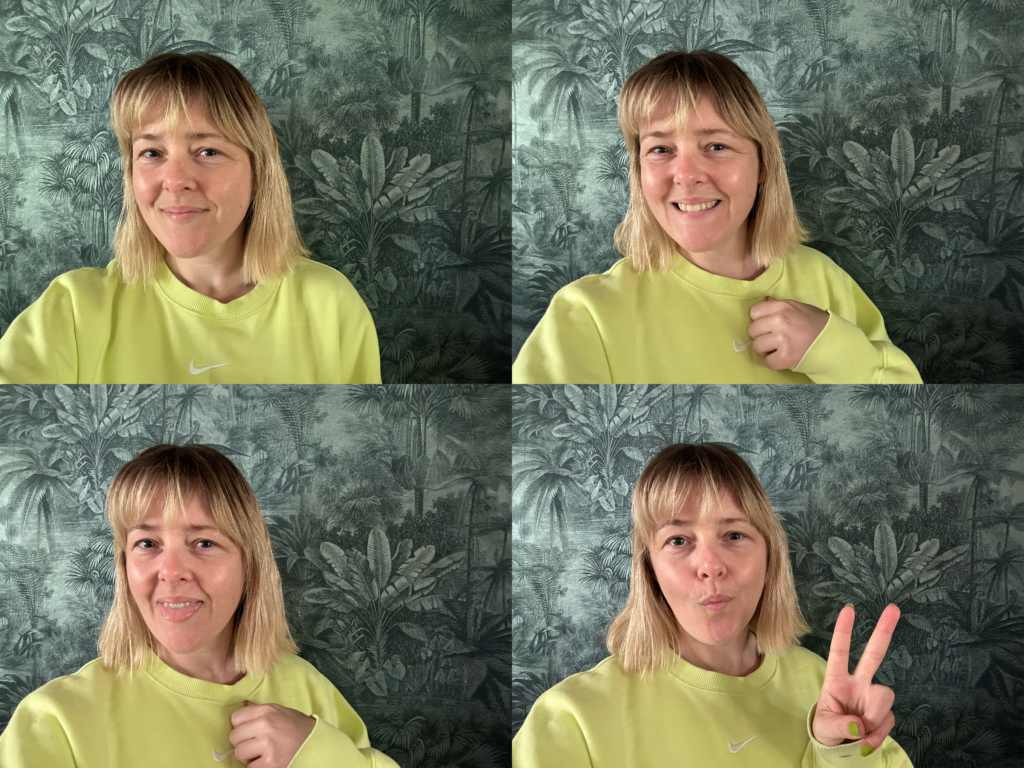
The smug face(s) of a woman who just wrote her first book
After years of people asking "how do you stay on top of everything?" and me trying to explain my systems over coffee, I finally wrote it all down.
Five principles for real life
It's the systems I use that stop my brain from overheating: task management that works when you're tired, email workflows that prevent dread, shared household systems so you're not carrying the entire mental load, and tax prep that stops end-of-year panic.
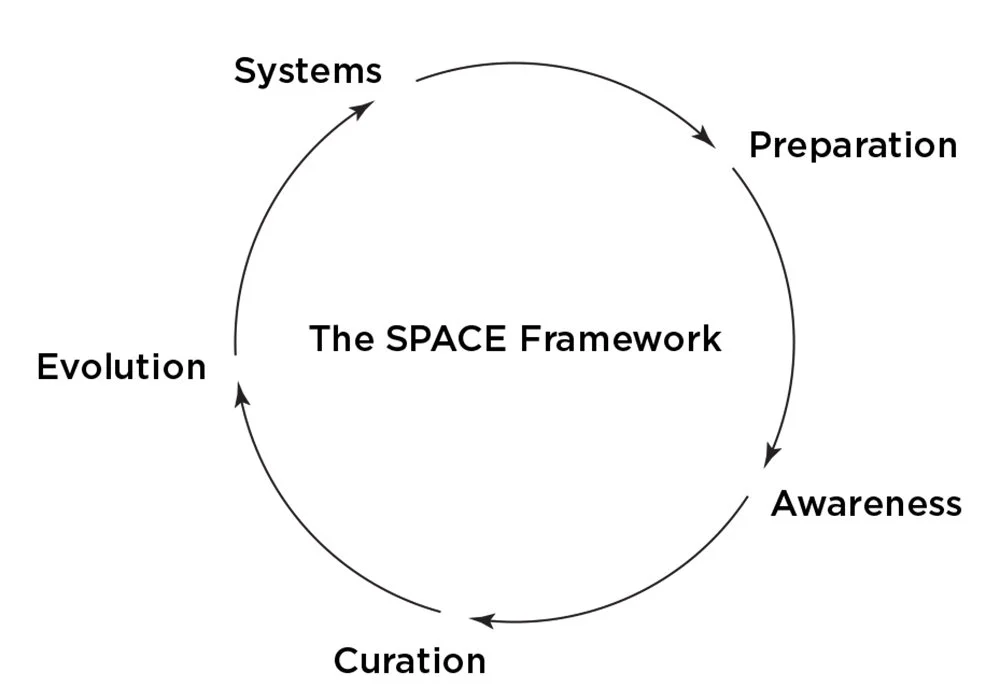
The SPACE Framework
This book gives you the SPACE framework: five principles I swear by, which you can use too.
Systems get tasks out of your head so your brain can think instead of store.
Preparation means small investments now (like learning keyboard shortcuts) that save hundreds of hours later.
Awareness shows you the gap between what you think you're doing and what's actually happening.
Curation protects white space by defaulting to 'no' so you have room for what matters.
Evolution accepts that systems break when life changes, and adjusting them isn't failure.
These five work as a loop: as circumstances shift, you move through it again. You don't finish being organised, you get better at the process.
The systems, with permission to adapt
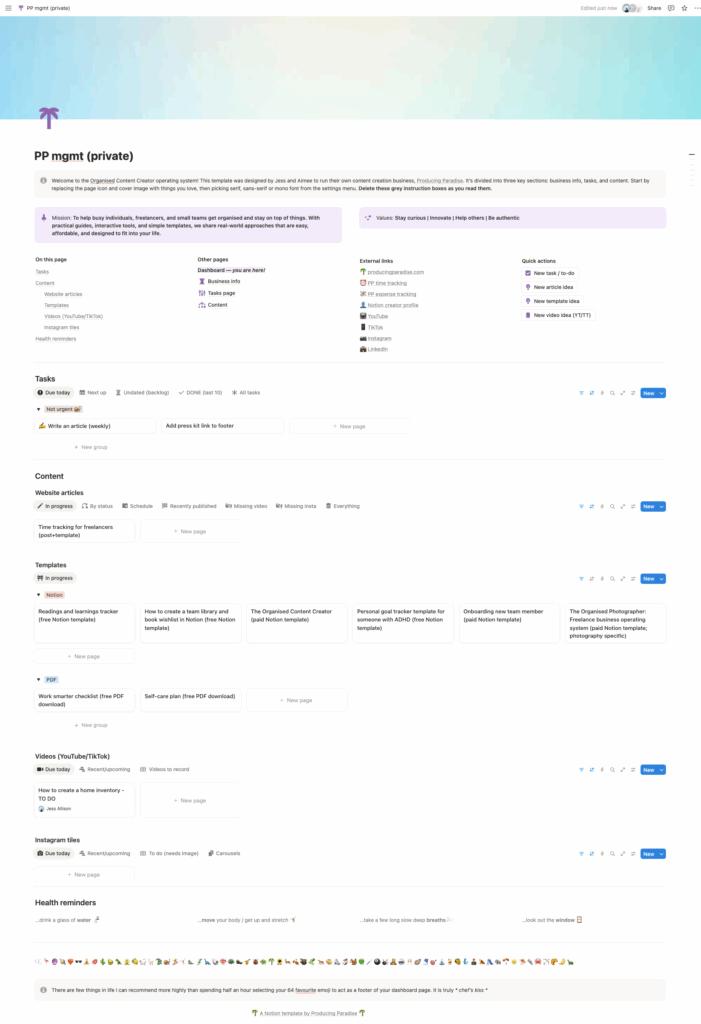
The Notion dashboard we use to manage Producing Paradise
The systems I use:
Task management that works with whatever tool you use, whether that's Notion, Trello, paper notebooks, phone notes app, or something else.
Email workflows so messages move through clear pathways instead of piling up.
Shared household systems that distribute the remembering, not just the doing.
Weekly reviews taking 30 minutes that prevent things falling through cracks.
Boundaries you can hold without guilt spirals.
There are techniques you can start immediately: task triage for decision paralysis, time audits that show where your 168 hours go, keyboard shortcuts that compound over a career, retrospectives that teach you what's working.
I tried to really cram everything in there, because I'm a real overachiever.
For anyone carrying it all in their head
Hopefully everyone, but specifically:
Freelancers managing multiple clients.
Parents drowning in household admin.
Small business owners wearing all the hats.
Anyone who's tried a productivity system that worked for two weeks, then stopped when life got chaotic.
Neurodivergent brains that benefit from external structure will find this useful, as these systems rely on getting things out of your head rather than trying to remember everything through willpower.
Principles over platforms
The particular app doesn't matter. The SPACE framework works with whatever tools you reach for when things get busy.
You won't find aspirational aesthetics or perfect morning routines in here. (Okayyy, I lay my clothes out the night before: my tired morning brain needs one less decision before coffee.)
The Most Organised Person I Know also includes my take on the human stuff: mental health, time in nature, relationships, boundaries, gratitude. These aren't optional. No system survives if you're ignoring your human needs.
Organisation creates space
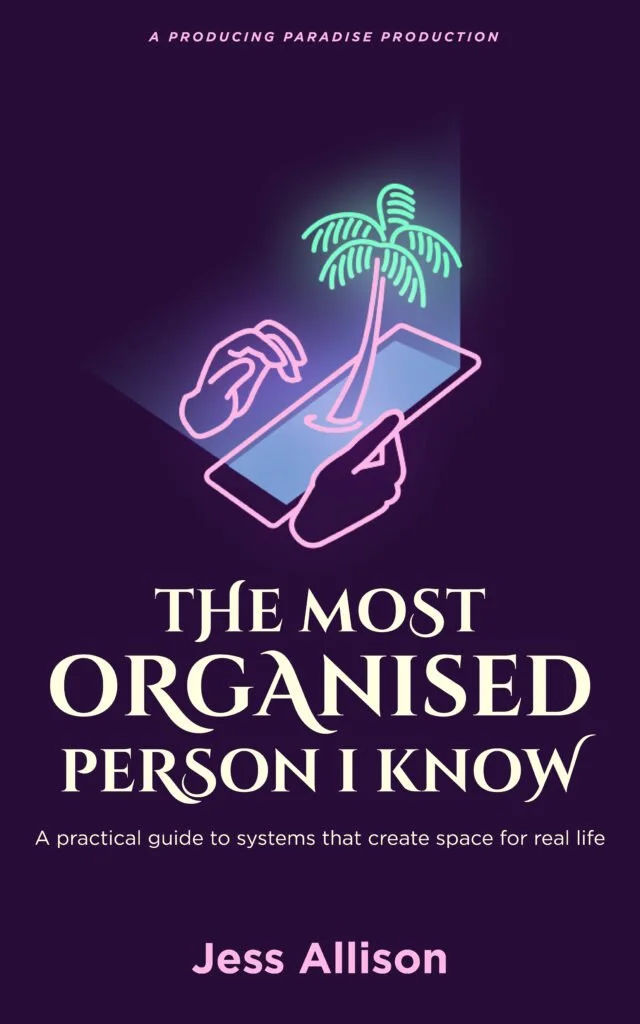
Cover art by my guy, Aaron Puls
When you're not mentally running through lists while you're supposed to be present with your kid, that's space. When you can close your laptop at 5:30pm and be done, that's space. And when you know your bills are paid and your tax is organised and nothing urgent is looming, that's peace of mind.
The goal isn't to create time for more tasks. It's to create space for the good stuff. Long walks. Naps. Doodling, dawdling, daydreaming. Being present instead of preoccupied.
My reusable coffee cup lives in my backpack, not the kitchen cupboard. That's a tiny system, but it means I don't have to remember to pack it. One less thing taking up space in my brain.
When I'm not trying to remember what I need for work tomorrow, I can be present with my daughter tonight.
That's what this book is about. Get your copy here!
AI stays in the appendix
There's an appendix about using AI as an organisational tool if that's your jam, and it stays in the appendix if it's not. I wrote the content myself, then used Claude as an editorial sounding board to help shape this manuscript from a reference manual into something with structure, before taking it to a real-life human editor for the final review. The full editorial process is in there if you're curious about how this came together.
FAQ
What format is the book available in?
Ebook now. Print version next!
Do I need specific apps?
No. Use whatever you already have. The framework is tool-agnostic.
Is this another aspirational productivity book?
No. This is about systems designed for how you live, not how productivity Instagram thinks you should live.
Can I try this before buying the book?
Yes. The free SPACE worksheet walks through the same five questions this book is built on, with two filled-in examples. It's a taste of the approach. The book has the full systems, workflows, and the human stuff behind them.
How long does it take to implement?
Some techniques start immediately. Others you'll build gradually. The 30 minute weekly review is the backbone, with everything else layered around it.
Will this work if I'm neurodivergent?
Yes. The emphasis on external systems rather than willpower and the permission to adapt everything makes this useful for neurodivergent brains.
I've tried productivity systems before and they didn't stick.
Systems break when life changes. The SPACE framework includes Evolution as a core principle. Adjusting systems isn't failure, it's how they survive.
Am I the target audience?
If you're tired of carrying everything in your head, a freelancer, parent, small business owner, or someone who wants to worry less and live better, then I think The Most Organised Person I Know will have something for you.
Ready to feel more organised without overhauling your whole life?
The Most Organised Person I Know is a practical guide to building systems that reduce mental load, support your energy, and keep working when life gets messy.
Inside you'll find:
The SPACE framework: five principles that underpin every effective organisation system (Systems, Preparation, Awareness, Curation, Evolution)
100+ practical organisation improvements with real examples
How I use these principles in my own life and how you can adapt them for yours
Designed for freelancers, parents, and small business owners who need systems that keep working during real-life chaos
Make space. Keep space.