Which Claude model should I use for what task?
The question to help you decide: what would a wrong answer cost? Here's a week of my real tasks, sorted by Claude model.
Summary: I was running everything through Claude's most expensive model, because I wanted the best result and the biggest model felt like the way to get it. Ask yourself this: what would a wrong answer cost? If it’s nothing anyone would notice, use Haiku (bulk jobs, lookups, reformatting). A five minute fix suggests Sonnet. Anything you'd redo from scratch, like drafts in your own voice or tax paperwork, go to Opus. Real money or months on the line, it’s worth Fable. When in doubt, start a tier lower, and split big jobs into two chats: think in the expensive model, execute in a cheap one.
Two days into May I checked my usage settings and found I'd spent an extra A$13.81 on top of the plan I already pay for. I'd even set a monthly cap to catch this exact thing. Two days. Oops.
I'd been running everything through the biggest model (Fable), because I wanted the best result, and surely the smartest model gets you the best result. Captions, meta descriptions, tidying my task board, all of it went through the same model I'd use to check the maths on our house settlement.
My mistake? The best result for a caption is just a caption that works. The big model writes the same caption but charges more for it.
Ask what a wrong answer would cost
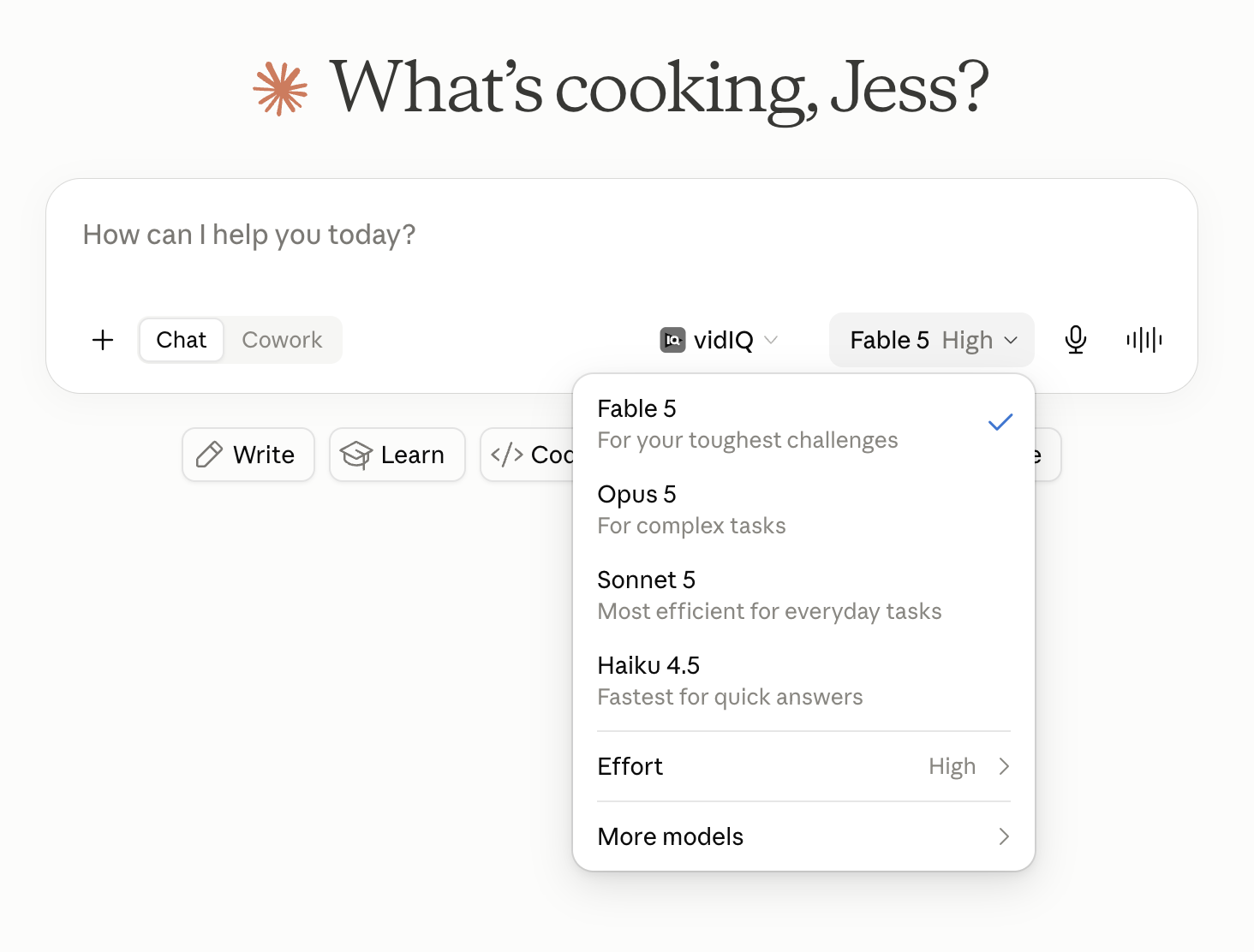
The Claude model picker
Now, before I start anything, I ask one question: what happens if this answer is wrong?
If nobody would notice, it goes to the cheapest model. If it costs me five minutes to fix, the default model is fine. If I'd have to start over, I go up a tier. And if being wrong costs real money, or months, it gets the top model.
Here’s your cheat sheet:
Free to be wrong = cheap model.
Expensive to be wrong = expensive model.
Claude's four tiers, as I write this in August 2026, are Haiku, Sonnet, Opus and Fable, cheapest to most expensive.
Here's what each one is built for, translated into plain language from Anthropic's own guide to choosing a model:
| Model | Good at | Use it for |
|---|---|---|
| Haiku | Speed and volume at the lowest cost | Quick lookups, sorting and categorising, reformatting, bulk simple jobs |
| Sonnet | Strong everyday intelligence, fast and cheap enough to use all day | Writing, standard coding, summaries, data analysis, general work |
| Opus | Deep reasoning and heavy-duty logic | Complex analysis, serious coding, legal or financial work, anything where a mistake means costly rework |
| Fable | The most capable model, built for long jobs it runs on its own | Big multi-step planning, dense source material, the hardest questions you have |
If nobody would notice, give it to Haiku
I recently wrote meta descriptions for eighteen articles in one sitting. If a couple came out flat, the fix was retyping a sentence. That's Haiku work: bulk jobs, quick lookups, reformatting, anything where you glance at the output and move on.
A bigger model wouldn't have written them any better. It would have just used up limits I wanted later in the week.
Lesson: every small job you send to the cheap model is usage reserved for more important work later.
Sonnet is your best default
When I cleaned up my Notion tasks board, 223 open cards became 122, mostly through merges, closures and moves. Every call was small and reversible; if I merged a card into the wrong place, fixing it was a drag and a drop. Hundreds of tiny, low-stakes decisions in a row is where the Sonnet model shines, and it's quicker than the big ones as well.
Captions, routine emails, internal first drafts, research summaries, clean-ups. If you’re using a higher model to do this stuff, that's the first thing to change.
Opus takes anything you'd redo from scratch
Some work has your name on it. Refining writing so it aligns with my tone and language, where one generic-sounding paragraph means rewriting the lot. Tax forms for our Amazon KDP account, where getting it wrong means redoing paperwork. Wrong here means starting again, so it goes up a tier.
It's also where teaching Claude your voice pays off, because voice is where cheaper models struggle.
Fable gets the ‘money-and-months’ decisions
When we were working out whether our house sale would cover the settlement on the next place, that’s a high stakes conversation. Same when I was deciding whether to self-host an automation stack, a choice that meant months of maintenance either way. These are the conversations where one subtle reasoning error costs real money or significant time.
The top model burns your limits fastest, which is fine, because you should barely be using it. Some weeks mine never gets opened, but when I have a complex decision with larger consequences, it’s Fable all the way.
Start a tier lower than you think
In April I caught myself wondering whether drafting captions needed an Opus-tier model. I write about productivity systems for a living. (So, you know, this happens to the best of us.)
When a task sits between tiers, start low and give the cheaper model the benefit of the doubt. Sending everything to the top is asking the CEO to do a job a junior would nail. You'll know within one reply whether it needs more model, and moving up is a single menu click. If you default to the higher usage model on every message, you never learn what the cheaper model could do.
Anthropic backs me up here. Their own model-choosing guide gives developers the same advice: start with the efficient model, test it properly, and upgrade if you hit a capability gap.
There's a speed bonus too. The big models think longer before answering, which can mean a few minutes of watching a spinner. Across a day of small jobs, the fast tier gives you your afternoon back.
Split the thinking and doing into separate chats
When a job has a thinking phase and a doing phase, use two chats. Work out the plan in the big model, then open a fresh chat on the default model, paste the plan in, and let it churn through the execution.
My Notion clean-up ran this way. The merge logic got decided once, up in the expensive model, and the hundreds of card updates ran cheap.
When the stakes are higher, add a third step: once the cheap chat finishes, hand the output back to the bigger model for a once-over. One review pass costs far less than running the whole job on the big model.
The same move applies any time you change models mid-job. A chat re-reads its whole history with every message, so a long thread gets dearer as it grows, whichever model you're on. Start a fresh thread on the new model and carry a summary across instead of dragging the conversation with you.
PROMPT (in the cheap chat): "Here's a plan another chat and I already agreed on. Work through it step by step without re-opening the decisions: [paste plan]"
PROMPT (to carry a chat across): "Summarise this chat so I can pick it up in a new one: what we decided, what's done, and what's next."
The same routing works outside Claude, by the way. Notion's custom agents let you pick a model per agent, and agent runs eat credits the way chats eat limits, so the question travels with you.
A week of my chats, routed
This article started as a Claude conversation. I asked it to sort my own chat history into the tier each task should have used. Here's the result. The last two rows are yours.
| Task | What a wrong answer costs | Model |
|---|---|---|
| Meta descriptions, batch of eighteen | Nothing anyone would notice | Haiku |
| Task board clean-up, 223 cards to 122 | Five minutes of re-tagging | Sonnet |
| Blog draft in my own voice | A rewrite, plus a bruised ego | Opus |
| W-8 tax forms for KDP | Redone paperwork, 30% withholding at stake | Opus |
| House settlement maths | Real money | Fable |
ACTIVITY: Scroll through your recent Claude chats and tag each one: would a wrong answer have cost nothing, five minutes, a redo, or real money? Then count how many genuinely needed the flagship.
When we ran the settlement numbers I didn't think twice about the model, and I didn't worry about limits, whereas creating social captions from my article content is almost an automation. Pick the model that clears the bar, and let the cheap ones keep the lights on.
FAQ
Which Claude model is the best?
The most capable is Fable. The best one for the task in front of you is whichever clears the bar, and for most daily work that's Sonnet.
Which Claude model is best for writing?
Depends what a miss costs you. Captions and internal drafts are fine on Sonnet. Anything published in your own voice is Opus work, because a generic draft there means a rewrite.
Which model for a resume or cover letter?
The resume is mostly a formatting job, so Sonnet handles it fine. The cover letter has to sound like you, and a generic paragraph gets spotted, so it's worth Opus. Same rule as everything else: the cover letter costs you more if it misses.
Is Opus better than Sonnet?
At deep, multi-step reasoning, yes. For everyday drafting and admin you'll struggle to tell the difference, which is why starting a tier lower loses you nothing.
What about effort levels and extended thinking?
If your plan shows those settings, the same question applies inside a model as between models. Default effort for everyday work, and turn it up only when the task would justify a bigger model anyway.
What if I pick the wrong model?
Nothing breaks. Re-run it a tier up. One click.
Model sorted? Now teach it to sound like you
Getting the tier right sorts out where your limits go. The next step is teaching whichever model you pick to write like you, so the voice-sensitive work stops needing rewrites.
The Voice Profile Builder is a free Notion template that walks you through capturing your writing voice in a form any model can follow.
GET THE FREE TEMPLATE →