Teach AI your voice

AI writing is average. Literally. It takes the average of everything it has read, so the default is bland and forgettable. Build a one-page voice profile to make any output sound more like you.
Summary: AI writes in AI voice because you've never described what your voice is. Feeding it your old posts teaches it your topics; your voice lives in the sentences you delete, and deletions don't show up in samples. To fix it: pull a banned-words list from your own drafts, look for common sentence shapes, and ask the model to describe your voice back so you can refine it further. Taking the time to create a voice profile will save time and effort in correcting writing later.
My voice profile
Who I am
Operations lead and solo creator. I write for time-poor freelancers. Plain, experienced, slightly informal.
How I sound
Short sentences. Plain words. A little dry. Closer to how I'd explain something to a smart friend than to a boardroom.
Tells to keep
Australian spelling. Sentence case headings. Short paragraphs. The occasional aside in brackets. No em dashes.
Never use
actually, strictly, delve, leverage, robust, seamless, comprehensive, game-changer, 'in today's fast-paced world', 'it's not X, it's Y'
Example of my voice
Instead of: In today's fast-paced digital landscape, leveraging robust productivity systems is crucial for success.
Write: Pick one system and use it. I dare you.
Standing rule
If a sentence sounds like a press release or a LinkedIn thought-leader, rewrite it or cut it. Lead with the answer. Prose over bullets.
Claude kept handing me writing with 'strictly' and 'actually' all over the place and I kept deleting them, but when I sat down to define my voice, I could specify banned words like these.
Here's how to teach AI your voice, using your own writing as the source.
Feeding it your writing is a good start
The obvious move, when you want AI to sound like you, is to paste examples of your writing and tell it to match them. It's not a bad instinct, but a finished piece of writing only shows what survived. It can't see the openings you wrote and scrapped, or the words you swapped out because they didn’t sound right. Your voice comes as much from the deletions as from the words left on the page, and a sample doesn't contain any of them.
So start by describing the deletions.
Your banned words are the gold
A banned-words list sounds cosmetic, like you're just swapping 'utilise' for 'use', but this is the most valuable work.
ACTIVITY: Pull your last three pieces into a document. Read them through and mark every word that makes you wince, plus every filler word.
PROMPT: "Here are three things I've written. List the words and phrases I use most often, and flag any that read as generic. Don't rewrite anything, just show me the patterns."
That list will be the first half of your profile: the negative space around your voice.
Identify your writing habits (and keep these!)
Cutting is easier than keeping. A bad word makes you cringe, whereas good habits stay invisible.
My habits for example:
I often open with an admission instead of a claim.
Sentences run on through commas when I'm building to something.
I don’t mind brackets for quirk (like this).
I didn’t clock any of this until I had to write it down. They're the positive instruction the model needs, the "do this" to sit alongside the "never that" from your banned list.
Sentence rhythm is next
You can easily point at the words you tend to use, but sentence rhythm is harder because it’s so innate. Left to its own devices, any AI model will produce sentences of roughly equal length, evenly paced, which is what makes AI prose feel flat even when the words are, like, fine. My writing doesn’t do that: it swings, with a long comma-connected run, and weirdly specific potentially unnecessary details. Then a short one to land it.
PROMPT: "Look at the sentence and paragraph lengths in this writing. Describe the rhythm: where do sentences run long, where do they snap short, how long are the paragraphs? Give it back to me as instructions I could hand to another writer."
Ask the model to describe you back, then argue
Once you've got a draft profile, hand it back and ask the model to describe your voice using only what you gave it. Where its description is wrong, you've found a hole in the brief. If it says your tone is 'warm and professional' and you were going for dry, the word 'dry' isn't in your profile yet.
You’re asking Claude to disagree: point out where my rules contradict each other, and where I've said 'concise' but every example I handed over runs long.
PROMPT: "Here's my voice profile. Describe how I write using only these rules. Then argue with me: where are the rules too vague to follow, and what would you still be guessing at?"
A voice brief that never changes won’t work
The first version of your profile is wrong. Not badly wrong, just incomplete, because you can't see all of your own habits in one sitting. So treat every draft that comes back sounding slightly off as data. When the model does something you'd never do, that's a missing rule, and the fix is to add the rule and leave the output alone. My profile has grown a line every time the writing drifted somewhere I didn't like. If yours hasn't changed since you wrote it, that's a sign you've stopped feeding it, not that it's finished. Hashtag continuous improvement.
The whole thing on one page
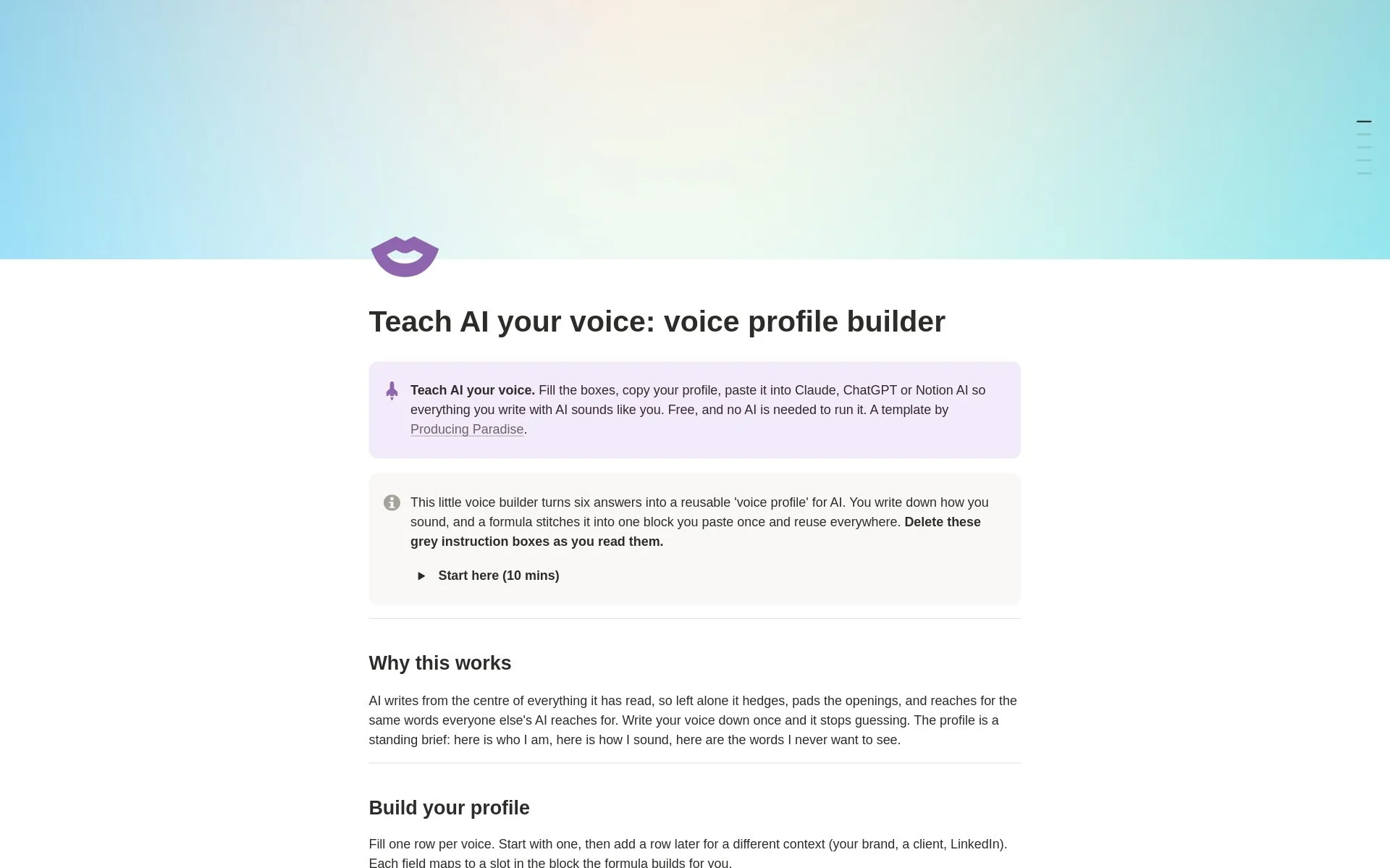
A voice profile is six fields. Guess what? You’ve already done the first two! The rest are quicker.
Where you put it depends on scope: A voice that applies to everything you write belongs in your custom instructions. A voice for one stream of work, your brand or a client, belongs in that Project's knowledge base, named in the instructions so it's applied to every draft.
| Field | What it captures | Example |
|---|---|---|
| Who I am | context and who you're writing for | Solo operator writing for other time-poor creators |
| How I sound | the tone, in a line or two | Dry, direct, a senior operator talking to a peer |
| Tells to keep | the moves that are yours | Open with an admission, comma-connected runs, the odd parenthetical aside |
| Never use | what you cut on sight | 'comprehensive', 'seamless', 'leverage', 'robust' |
| Example of my voice | one rewrite that shows the shift | 'leverage your tools' becomes 'use what you've got' |
| Standing rule | the one instruction that governs the rest | If a sentence could sit in anyone's post, cut it |
ACTIVITY: Fill in the six fields for one context: your brand, a client, your newsletter. Keep it to a page. That page is what you paste in front of every prompt, and it does more for the output than any amount of prompt-wrangling after the fact.
Before and after: Write me a two-line intro for a post about tidying up my task list
No voice profile
“In today's fast-paced world, staying on top of your tasks is more important than ever. Let's dive into some simple, effective strategies to help you streamline your workflow and boost your productivity.”
With voice profile
“Staying on top of your tasks doesn't need to be complicated. Here are a few strategies that work.”
Teach AI your voice: voice profile builder for Notion
If you'd rather not build the scaffold from scratch, I put the six fields into a Notion template, 'Teach AI your voice'. It’s free! You answer six questions and a formula stitches them into a profile you can paste into Claude, Notion AI, or wherever you write. You don't need Notion AI to run it.
Claude still offers me plenty of bad writing, but it’s getting better with every voice profile edit, and I understand my own writing style better than ever. Cool, huh?
FAQ
Do I need Notion AI to build a voice profile?
No. If you use the template, a formula does the assembly, so you just answer the six questions. If you're building it by hand, any AI tool will help you pull the patterns out of your drafts, but the profile itself is just text.
Why not just give the AI samples of my writing?
Samples show it what you write about and what you chose to keep. They can't show it what you deleted, and a lot of your voice lives in those deletions. A profile describes the deletions directly.
Will one profile work across Claude, Notion AI and other tools?
Yes. It's plain text, so it works anywhere you can paste a brief: a system prompt, custom instructions, or the top of a chat. You can also keep a separate profile per context, one for your brand, one for a client, one for your newsletter.
What if I've only got one or two pieces to pull from?
Start with what you have. Even one piece you're proud of will surface a few banned words and one or two habits. You extend the profile as you write more and notice the model getting things wrong.
I don’t want to use Notion, what else have you got?
Here’s a PDF worksheet with the same six fields you can fill out online or by hand, if that’s more your jam.
Voice profile sorted? Now sort the rest of your workflow
Teaching AI your voice saves correction time. Good systems save time everywhere else.
Could you use a central hub for your freelance work?
The Organised Creative Notion Template helps you track projects, manage deadlines, and store important info so you spend less time on admin and more time creating.
EXPLORE THE TEMPLATE →
How about systems that work across your whole life?
The Most Organised Person I Know shows you how to design simple systems that reduce mental load and help your work flow more smoothly, from daily tasks through to long-term projects, at work and at home.
GET THE EBOOK →
Because the best systems are the ones you set up once and stop fighting.