The next 1,000 days: what to do while the rules of work are being rewritten

AI is unbundling what employment provided beyond a paycheck: identity, purpose, community, structure. Here are four moves to strengthen your foundations.
Updated July 2026
Summary: AI is reducing the cost of cognitive labour fast enough to destabilise the bundle of things employment has always provided beyond income: identity, community, purpose, and structure. Freelancers and small operators face the disruption on two fronts at once, because AI threatens the income dimension directly while they already lack the institutional buffers that employees rely on for the other four. The instinctive response, working harder, recreates the original problem in a new container. Four moves matter: audit what your work currently provides across the five dimensions, build one system you own outright, invest in judgment over execution, and run a monthly alignment check to catch drift before it compounds.
I was folding laundry when it started. An episode I'd idly saved to my queue, How AI Could Change Everything in the Next 1,000 Days from The Next Big Idea Podcast, began playing. Eighty-one minutes later I was standing in my kitchen with a cold cup of tea, trying to process what I'd heard.
The episode features Emad Mostaque, who co-founded Stability AI and has since written The Last Economy. His argument, compressed: AI is making human intellectual labour so cheap and abundant that the economic logic underpinning how we work, earn money, and find meaning is going to come apart. He thinks the window for meaningful response is roughly one thousand days.
I'm not going to tell you whether his timeline is right, because I don't know. Neither does he. The underlying argument, though, is harder to dismiss than the usual future-of-work-and-AI content. One idea stayed with me enough that I want to work through what it means.
Work has always been doing five jobs at once
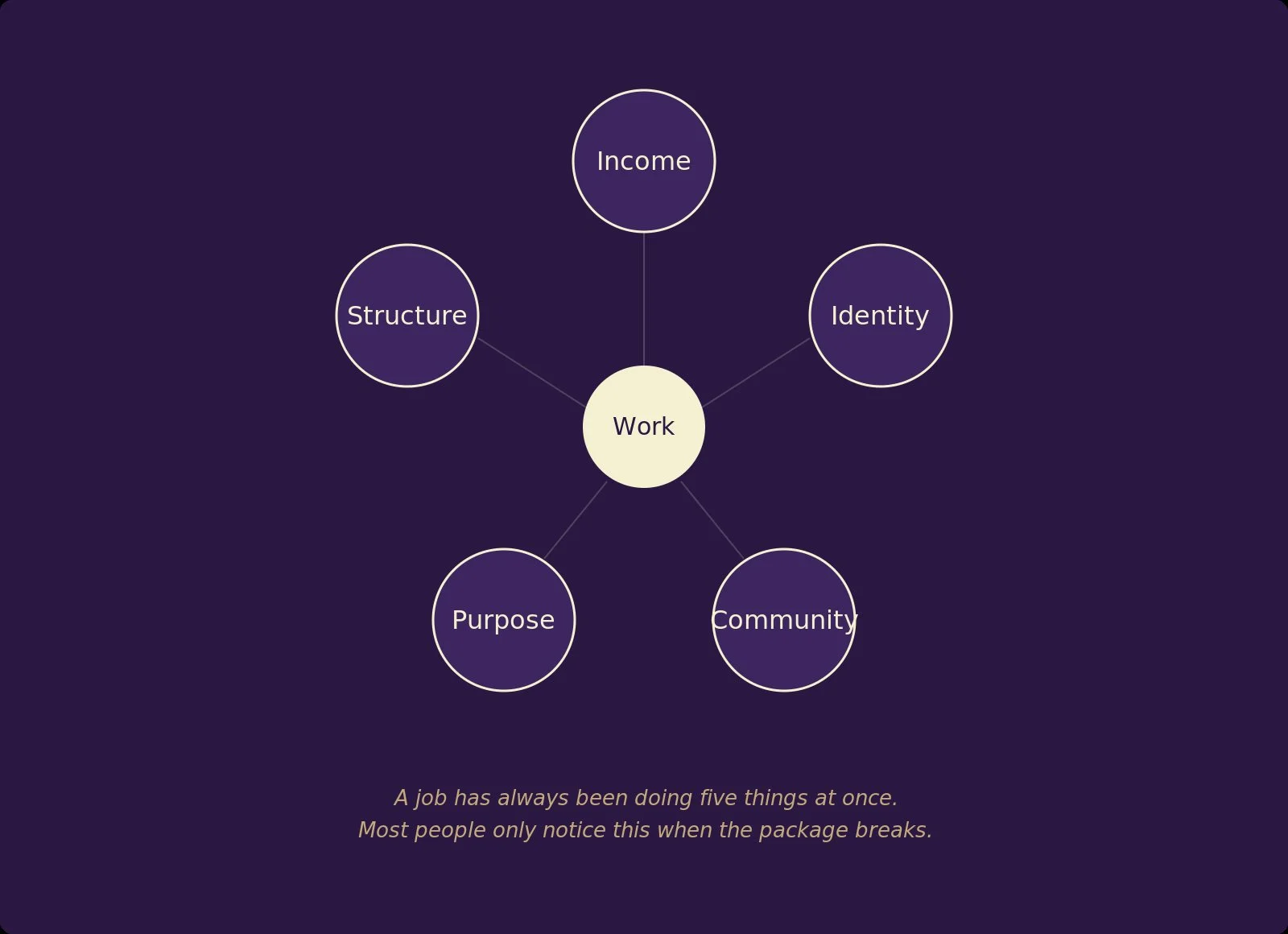
A job has always been doing five things at once.
A job has always been doing five things at once. We notice this most when the package breaks.
Income, yes, but also identity (what you tell people you do), community (the people you spend most of your time with), purpose (the sense that your effort contributes to something that matters), and structure (a reason to get up at a particular time, a rhythm that organises your week and anchors your days).
For most of the industrial era, those five things came packaged together. You didn't have to consciously construct any of them, and the dependency stayed invisible until the package broke, through redundancy or burnout or the decision to go independent, and suddenly all five had to be found from scratch.
A graphic designer who leaves a studio to go freelance knows this immediately. The income calculation was obvious. What wasn't: they also left a team that was their daily creative community, a studio reputation that gave their work a context and a certain prestige, a job title that gave strangers a shorthand for who they are, and a Monday morning standup that imposed a rhythm on their week. Within three months they've gained autonomy and quietly misplaced four out of five things they were relying on.
The bundle only holds while the work is continuous and central
The causal link is the piece that's easy to skip past in the general AI commentary, so it's worth slowing down on.
Employment only provides those five things when it's continuous and central. When you're in the same role, with the same team, for the same reason, for long enough that identity, community, purpose, and structure can settle into place around the paycheck. Make the work shorter, more project-shaped, less stable, more automated at the margins, and each of those dimensions starts to thin out. Income pressure gets the headlines because it's measurable and immediate. The quieter losses, the identity confusion and the structural drift and the community gaps, tend to go unbudgeted for and hit later.
Mostaque's argument is that AI is going to unbundle this at scale. As cognitive labour becomes cheaper and more automatable, employment becomes less stable, employment becomes shorter and more project-shaped, and the scaffolding that most people assumed would always be there becomes intermittent.
Freelancers: you're on two edges of the curve
There's a comfortable reading of the unbundling argument that goes: if you already run your own business, you've done the hard work, you're out in front. This doesn't hold up.
Independent operators have always had to source most of the five dimensions themselves, which is part of why running a small creative business is more cognitively demanding than a comparable salaried role. You're doing the work and figuring out what the work is for. There's no job title doing the identity work for you, no team across the hall absorbing you into community. Purpose has to be built from scratch when there's no organisational mission to borrow from. Structure is whatever you can hold together between project ends and client changes.
What the comfortable reading misses is the second edge. AI disrupts cognitive creative work more directly than it disrupts institutional roles. Copywriters, designers, photographers, strategists, illustrators: the cost curve is collapsing most visibly in exactly the categories independent operators occupy. You have the least institutional buffer and the most direct exposure. The income dimension you've been holding together by hand is now sitting under the same automation pressure as everything else, while structure, community, identity, and purpose were always thinner to start with.
An architectural photographer between major commissions feels this concretely. The income gap shows up first because it's measurable. Quieter losses arrive later: the dinner party where someone asks what you've been working on and the honest answer is 'headshots, mostly,' or Tuesday at 11am with nothing scheduled and no obvious reason to start the thing you're avoiding. Now layer on top of that the possibility that the next three clients will accept a first-pass AI-generated version of what you used to be hired for, and the gap widens faster than anyone quite planned for.
The infrastructure argument matters more for you. Whether or not Mostaque's thousand-day timeline is right, you were always going to need this scaffolding, and AI just removes the option of building it slowly.
The instinctive response makes it worse
When the scaffolding gets wobbly, the natural move is to work harder, taking on more clients and tightening up the systems. This makes sense as a short-term response to financial pressure, and it recreates the original problem in a new container over any longer horizon. You're still tying your stability and sense of worth to throughput, just without the job title to justify it.
The harder-working version is worse: productivity systems that optimise how quickly you move through tasks but never ask whether those tasks are pointing anywhere worth going.
The diagnostic question is blunt: if your system breaks the moment you get busy, it was never working in the first place. Anything that fails under load was dressing up as scaffolding without doing the load-bearing work.
Build your own scaffolding
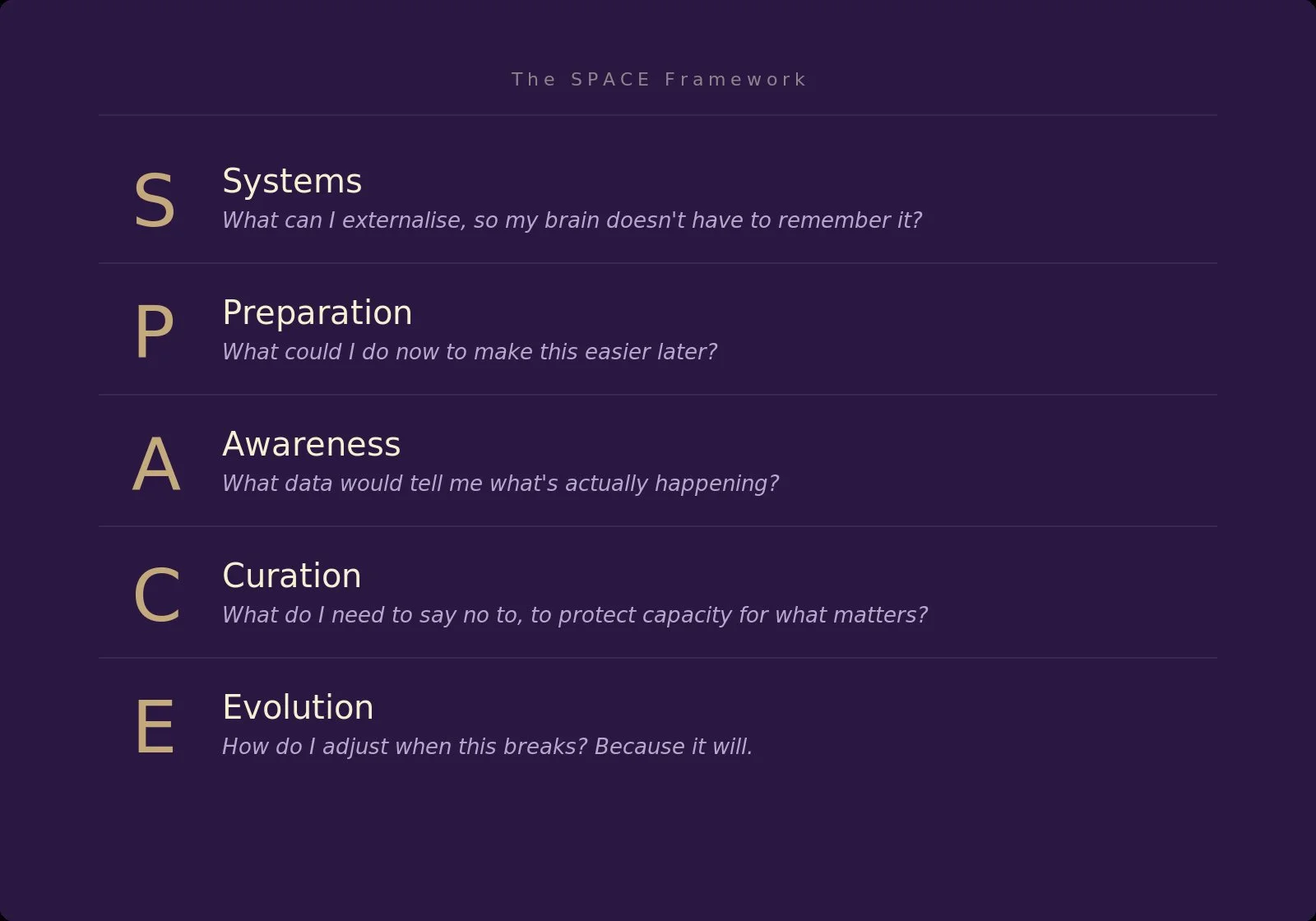
The SPACE framework
The response is to build something that provides the five dimensions independently of any particular income stream, client, or employer. A personal operating system. A layer of structure, values, and decision-making that sits above the day-to-day work and tells you what you're doing and why, regardless of what the work itself looks like in any given month.
A personal operating system makes your values visible as daily decisions instead of vague aspirations you revisit once a year. The structure is one you own outright, independent of an employer's calendar or a client's urgency. When the work shape changes, you adjust within a consistent framework rather than rebuilding from scratch every time.
The SPACE framework is how I build that layer. It's five principles, and each one does different work against the five bundle dimensions. Systems and Preparation cover the structure dimension, the daily clarity and rhythm that used to come from a salaried role. Awareness and Curation take on identity and purpose, telling you whether what you're spending your time on matches what you said mattered, which is the work that performance reviews used to do inside organisations. Evolution gives you the mechanism for change, so the framework adapts when the income shape shifts or the community around you changes. The bundle is what you're protecting. SPACE is the method.
I use Notion for this, but the tool is not the point. The goal isn't to build more in it; it's to build just enough that your work is clear and stays clear when things get busy. An hour spent designing something you'll maintain is worth more than a week building something elaborate that you'll abandon when a quarter goes sideways. If updating the system feels like a separate task on your list, it's too heavy to survive a busy month.
Four things worth doing now
Make investments that will compound, the kind worth making while you have cognitive space and relative stability, which are harder to do well under pressure.
1. Audit the bundle
Write down what your current work provides across each of the five dimensions. Be specific rather than aspirational.
Income: is it reliable enough that you're not operating on financial anxiety?
Identity: do you have a clear answer to "what do you do" that you believe?
Community: do you have professional relationships that feel genuinely reciprocal?
Purpose: can you articulate what your work is for in terms that would still hold if a particular client or project disappeared tomorrow?
Structure: does your working day have a rhythm you chose rather than one you fell into?
A freelance illustrator might score income as variable but manageable; identity as clear in their own mind but hard to explain to people outside the industry; community as thin (the clients aren't colleagues, and working from home removes even the casual contact of a shared studio); purpose as strong when the work is the artistic, character-driven projects they built a reputation on, and hollow for the bread-and-butter corporate work that follows strict brand guidelines and leaves no room for judgment; structure as whatever the current deadline imposes. The gap is usually purpose. The work isn't bad; the ratio between the work that fits and the work that pays has drifted without anyone deciding it should.
The gaps show where you're most exposed. They're also where a small deliberate investment makes the biggest difference. The dimension you've kept deferring because something more pressing keeps showing up is the one to start with.
2. Build one system you own outright
The goal is something you control end to end. Anything built inside someone else's platform can be repriced or taken away. Anything tied to a single client's preferences disappears when the relationship ends. What you're after is a layer that captures how you think, what you're working on, and why it matters, in a form you own.
The temptation is to build something comprehensive, though the more useful version is the simplest one that works. For a freelancer, that might be one tasks database, one projects view, and a daily dashboard that tells you what to do next without requiring you to reconstruct your week from memory every morning. If it takes more than a couple of clicks to see what matters today, the structure is in the way rather than doing its job.
Tracking things you don't act on is building for reassurance. Pare it back until what remains is only what you use.
3. Develop judgment over execution
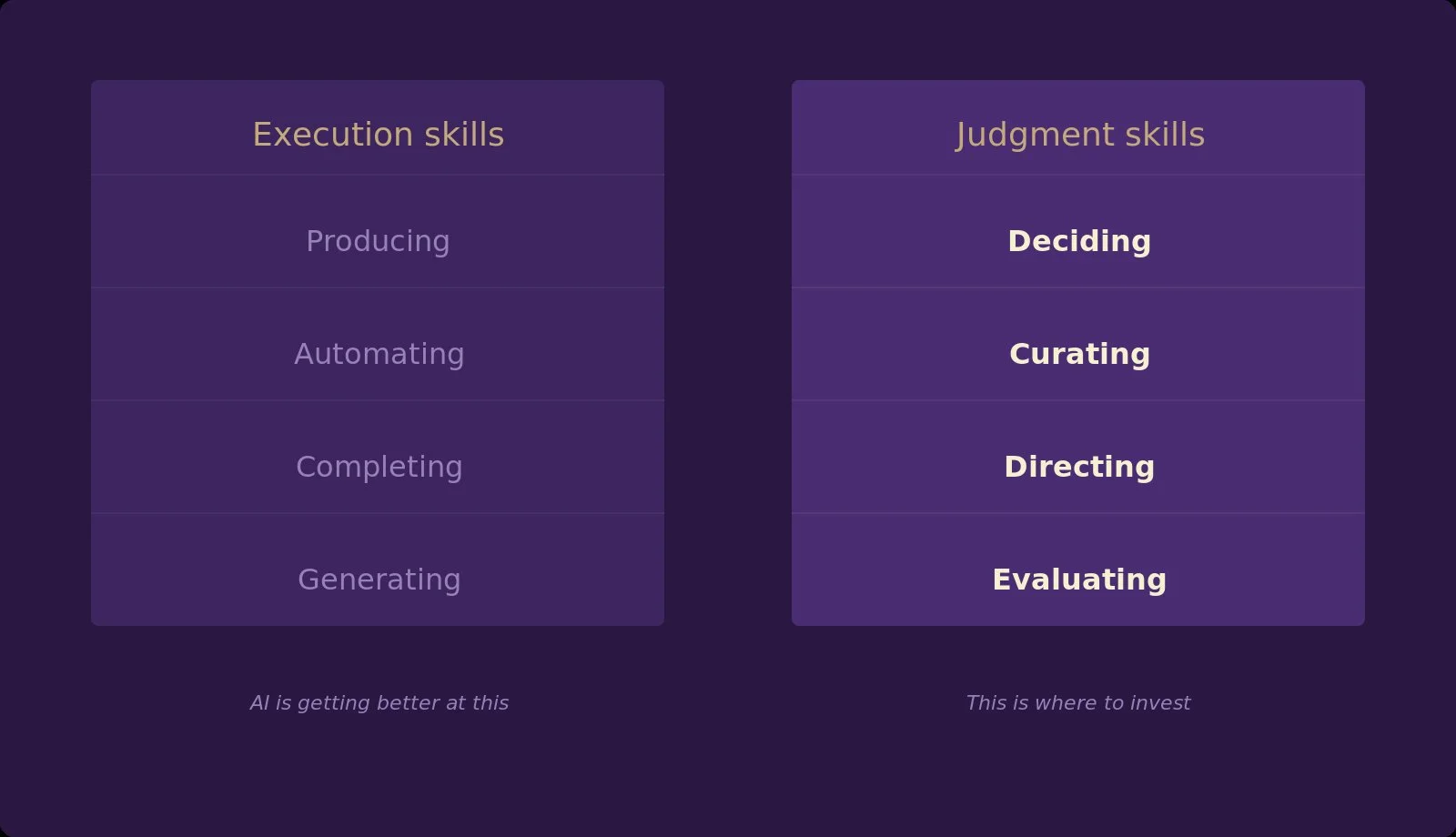
AI is getting better at the left column. The right column is where to invest.
Mostaque distinguishes between computation (answering "how") and what he calls consciousness: the capacity to decide what's worth doing and why. AI is getting better at computation faster than most predictions suggested. The latter remains irreducibly human: taste, values, the ability to make a call about whether something is worth making at all.
Every capability you build that's about deciding, curating, or directing has a longer shelf life than one that's purely about producing. This isn't about avoiding technical skill; it's about which layer of the work you're developing. The person who can evaluate AI output and know what's missing is doing something different from the person who's trying to outproduce the AI.
A photographer who can art-direct an AI retouching pass, who knows when the skin treatment has gone clinical and what a particular client brief is really asking for, is doing something different from the photographer trying to learn to retouch faster than the software.
4. Run a monthly alignment check
Once a month, look at what you spent your time on and compare it to what you said mattered. Drift is the enemy, and catching it early is a small recalibration.
The gap between stated priorities and the ones your calendar actually enacts is information. Caught early it's a small recalibration; left to run for three or four months it becomes a structural problem that requires an uncomfortable conversation with yourself ('how did I forget to invoice for that extra day?' or 'I find deep fulfilment in photography and seem to keep getting more design work instead').
An hour a month covers it. Did what I spent the month on match what I said I was building towards? If not, what needs to correct?
Be a person with a purpose
Mostaque says, almost in passing, that the machines haven't stolen our purpose; they've cleared away the debris that was hiding it. Either the most optimistic reading of a disruptive moment, or the most useful one, depending on how prepared you are to answer the question it leaves in the room.
What are you doing this for?
The answer that holds when a client goes quiet, when the momentum stops, when you can't quite remember why you started, is the one that matters. The website version is the easier one to write.
FAQ
I hate AI. Why should I care about this?
This is about what employment has always quietly provided beyond income, and what happens when that becomes less reliable. The five dimensions are worth building deliberately whether or not Mostaque's timeline is right. AI makes it more urgent; it doesn't change the underlying logic.
I'm already stretched thin. Building a personal operating system sounds like more work.
The starting version takes an hour or two. Audit what your work currently provides across the five dimensions. Find the thinnest one. Build the simplest system you'll use. Complexity can come later if you genuinely need it. The habit of checking compounds well before the sophistication of the setup does.
How is this different from setting goals?
Goals are destinations. An operating system is what decides which destinations are worth heading for and keeps that visible when you're deep in execution. Plenty of people have goals. Far fewer have a way of checking whether their daily decisions are pointed towards them.
Does AI change what a personal operating system looks like?
In the execution layer, yes. AI can surface where your time is going or draft a weekly review. The values behind the framework and the judgment calls about what to prioritise stay yours, though. The tool tells you what's happening; you still decide what to do about it.
Everything I build around these ideas is on my Notion marketplace profile, with free templates, free agents, and one full operating system if you want it ready-made rather than built from scratch.